








Former Minister of State for Health and Social Care Will Quince speaks to us about the Babies Bill and why the first 1,001 days of a child’s life should be protected in law.
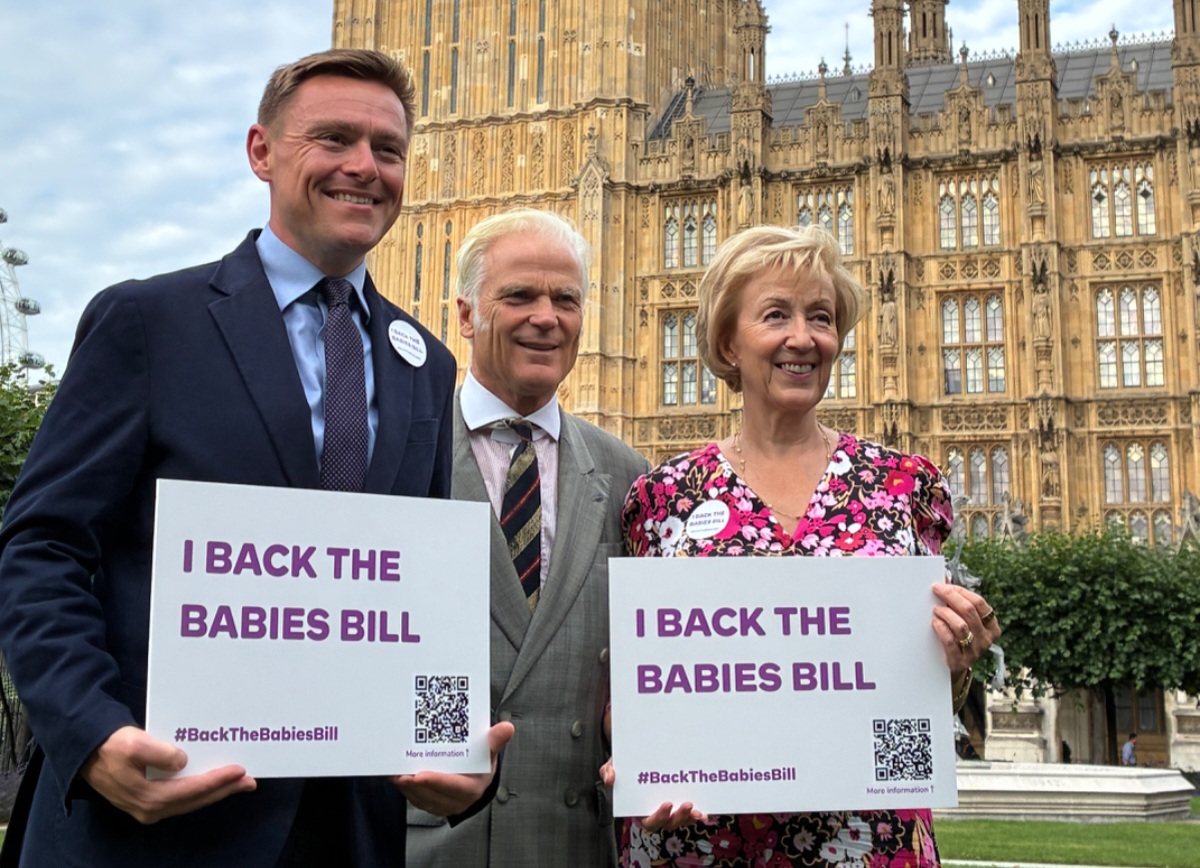
Image from left to right: Will Quince, Sir Desmond Swayne and Dame Andrea Leadsom
Last month, we reported the Infants, Parents and Carers Bill – known as the Babies Bill – had passed its second reading in the House of Commons.
First introduced by Conservative MP Sir Desmond Swayne, the legislation focuses on the life of a child from pregnancy to their second birthday.
Quince, chief executive of the 1001 Critical Days Foundation, has been working with Swayne on the legislation. He discusses its progress so far and why he believes this period is so important.
The 1001 Critical Days Foundation supports the Babies Bill. Could you explain how it came to be involved with the legislation?
We’ve been working really closely with Desmond Swayne. Our mission is to create a world in which every government recognises the importance of the first 1,001 days, from pregnancy to age two, and prioritises it.
Desmond was really keen to do something that would make a difference for generations to come. We were talking to him about one thing he could do that would, for the first time, put the critical period from pregnancy to age two into statute.
Any future government, whatever its political persuasion, couldn’t come in, even in the tightest fiscal circumstances, and say, “Primary education: is that an aspiration? Do we really need that?” It’s a given because it was enshrined in law. The same principle could apply here.
Interesting that you mentioned we’d never question whether children need primary schools. How do we give babies that same protection?
They need adults and politicians to advocate for them. Often, when you’re in the thick of parenting, you lap up the support that’s available, but you might not think about what more might have helped.
Nearly every parent will have guilt about something they did or didn’t do. Being a first-time parent can be a really tough experience, particularly when you add in things like insecure housing or poverty. There are parents who are trying their best, but they just need some extra support and information.
As a father yourself, is there any support you would have liked when you first became a dad, that wasn’t available?
You’re testing my memory a bit, it was 14 and 10 years ago. We had brilliant midwives and health visitors and we lost our son between our other two pregnancies, so we have some experience of some of the best of the NHS, actually.
I’d definitely like to see more support for dads in the process, especially around perinatal mental health support, given what I know from the research we’ve done into dads and suicide rates.
We commissioned some really sobering research from Swansea University which found dads with a child under two are seven times more likely to die by suicide than mums.
I could go on really, there’s so much more that we could do. The key is taking the best of family hubs, which bring support and services for families together, and making sure it’s rolled out to the rest of the country.
Do you think your background as a minister in the Department of Education and Department of Health and Social Care shaped your approach to the bill?
Yes, definitely. When you’re in politics you’re dealing with burning platforms, whether that’s school readiness or educational attainment, youth violence or mental and physical health, you see the human and financial costs and you think ‘how could we have got ahead of this?’
The reality is, in the vast majority of cases, if we’d have got babyhood right, we wouldn’t be in the position we are today. The more you look at the evidence, the period between pregnancy and age two is so critical in terms of building the foundations for a healthy society. If we get that bit right, and actually, it’s relatively inexpensive, then everything else will flow.
I noticed the Foundation funds charities that support parents affected by domestic abuse and other challenges. Why is that work so important to you?
That was actually in our first round of funding, an amazing charity called For Baby’s Sake, and they do such incredible work.
We know something like 30% of all domestic abuse starts during pregnancy, so we know it’s a huge problem. I’m not an expert on their work, but I do know they do a lot of work with couples to prevent and prepare parents for what is going to be a big adjustment.
We’re really proud to have funded the work they do and we support evaluation of their work as well.
So, coming back to the Babies Bill, how did it feel to hear that it had passed its second reading?
I was amazed because it’s quite rare that private members bills go on to become law. I knew in advance that, all being well, the government supported it, but you only need one person to talk it out or not sit down towards the end of the session, and then it falls apart.
It was a nerve-wracking experience, but at the same time, to hear MP after MP from all around the country, from all parties, sharing personal experiences and talking about the difference it’s going to make in their constituencies, was fantastic.
It’s not often you find bills that bring everyone together. There wasn’t a single person who didn’t say the bill wasn’t a good thing.
Are you expecting any hurdles as the bill moves onto the committee stage?
Inevitably there will be. The big hurdle is the second reading; the committee stage now is when MPs go through the bill line by line.
It’s likely to be in October that will start, but it’s not a very long or complex bill, so I don’t think it’ll take very long, but I suspect there will be potential amendments that they’ll want to look at and debate.
Bills can easily become Christmas trees, where people tend to add baubles on. The beauty of this bill really is its simplicity and the detail comes in secondary legislation. What we can’t risk is losing government support by adding in lots of things – if they make it too unpalatable for the Treasury, we might lose support and then it’ll just become another bill that didn’t make it, which would be a huge shame.
If the bill receives Royal Assent, what is one of the first things you would like it to achieve?
You won’t see some huge significant change because the bill is putting what already exists, the Best Start Family Hubs programme and the Healthy Babies programme, into statue. But the key thing is that assessment of need will then be periodic.
The government will be consulting with parents at least every three years on what they want in order to be confident and competent, and reporting to parliament annually on provision and outcomes. It’s an accountability mechanism, but it shines a spotlight on those services, which is why I think it will inevitably grow.
Image credit: Elin Roberts
Other interviews:
‘Disabled people are being regarded as an expensive luxury’: Mik Scarlet on disability rights
‘Everybody needs somebody rooting for them’: Emma Williamson on supporting care-experienced children
Leave a Reply