









With local elections imminent, there’s lots of talk about what councils can and should be doing to engage residents in the process — especially those residents who, for one reason or another, don’t usually vote.
Of course, budgets are limited and there are constrained resources. That’s why the mock elections held in the London Borough of Bexley are of such interest…
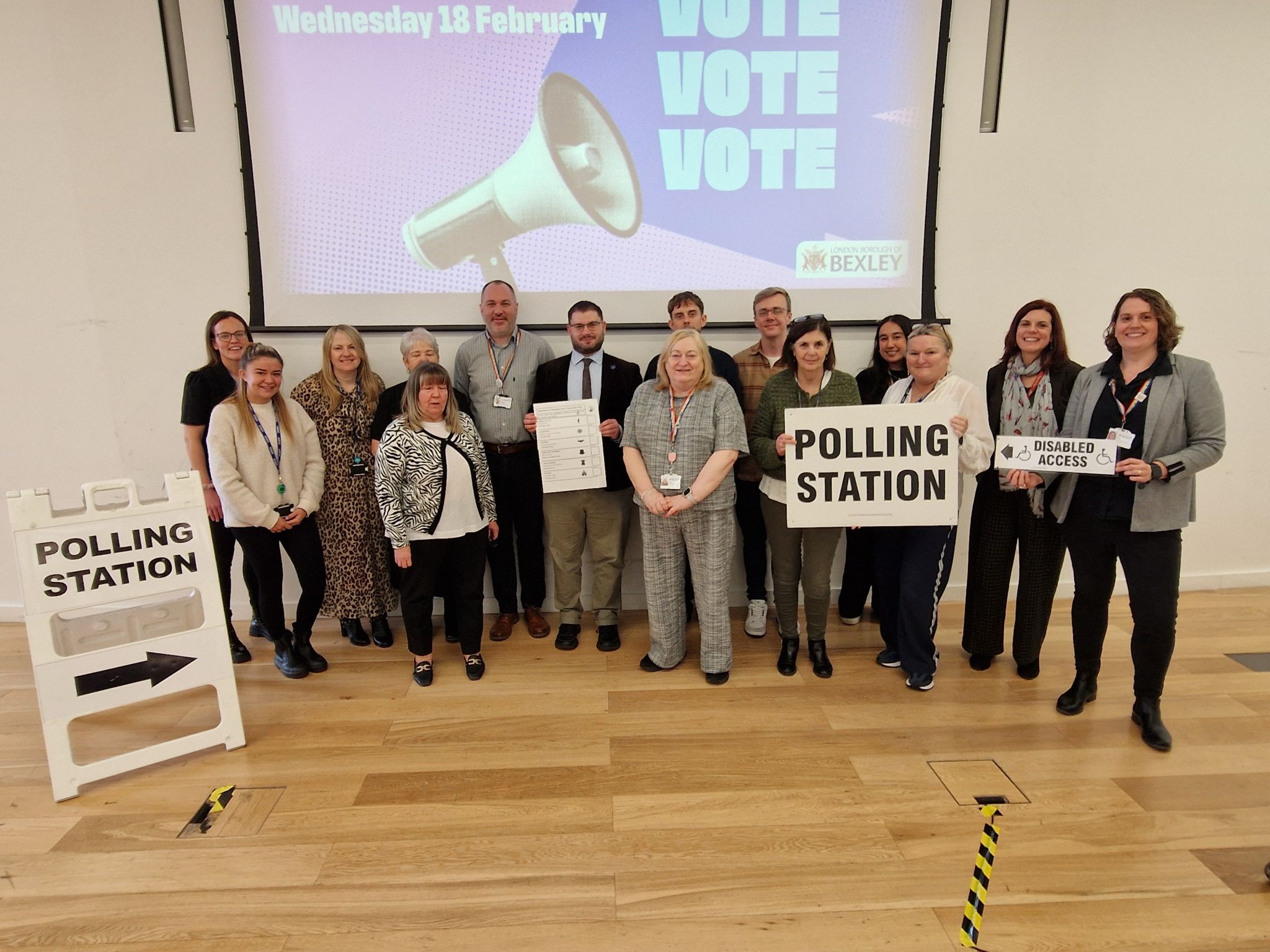
Image: Learning Disability Partnership Board in Bexley
What prompted you to set up mock elections?
Elizabeth Deeves, Head of Integrated Commissioning for Learning Disabilities and Physical Disabilities: It came from the people we work with. I co-chair the amazing Learning Disability Partnership Board in Bexley, alongside somebody with lived experience of a learning disability. At least 50% of the people who attend that board have a learning disability, so it’s very much based with them — and isn’t just commissioners and providers of services saying, ‘This is what we should do.’
The mayoral elections in London in 2024 introduced the requirement to have photo ID. Not everybody with a learning disability has the chance to go abroad so they might not have a passport, and relatively few have a driving licence. We were concerned about that and rather naively asked, ‘Will you be going to vote?’ People answered, ‘What is that? How do we do that?’ So I spoke to my colleague, Laurel…
Laurel Brewster, Head of Electoral Services: Electoral services can sometimes be in a silo of their own and don’t interact with anyone else. But at Bexley we all work on the same floor at the council, so it was easy to have a coffee and chat with Elizabeth, and talk through the concern.
Elizabeth: Laurel then gave this amazing presentation to the board about what was involved in elections, and she was inundated with questions. The obvious thing was to run a mock election so people could get involved and try it for themselves.
Maria Migdal, Communication Material Content Lead, Adult Social Care: We sent invitations to about 300 local people with learning disabilities of different kinds. For that first mock election, about 100 of them came along.
What did this first mock election involve?
Laurel: We put up polling booths in the reception of the council building. We had the local electoral register there, because we wanted people to be able to see their name on the real register. For those that didn’t have the photo ID they needed to vote in a real election, we set up a corner where they could bring along their national insurance number and some other form of ID. We could then take their photo and put all the details into the online government portal. A few days after that, they’d been issued with a voter authority certificate.
People of all different ages and backgrounds came along, and many had never been in a polling station before, all standing in line to give their name and address, and then be issued with a ballot paper. It brought tears to my eyes!
What was on the ballot paper for the mock election?
Maria: It couldn’t be real political parties or people because the council has to be apolitical.
Laurel: For that first election, the vote was on their favourite food. The choice was between things like fish and chips, McDonalds or roast dinner.
Adam Smith from Learning Disability Partnership Board attended the mock election: It was fantastic. It made people who thought they can’t vote because they have a learning disability think, ‘Actually, I can! I’m over 18, I can do this.’ I voted for roast chicken.
Laurel: Adam has remembered that from two years ago, which shows the impact it had on him.
Did the mock election make you feel more confident about voting, Adam?
Adam: I felt confident already but many of my friends didn’t. They weren’t comfortable with voting.
Elizabeth: Do they vote now?
Adam: Yes, I know two of them that do.
Laurel: I think any of us can find it a bit daunting to walk into a polling station, and I try to teach polling station staff to look out for people who seem unsure or nervous. One poignant thing from these mock elections was the older man who said to me that he never knew that he could go into a polling station and ask for help. By the end of the session, he was saying, ‘I am going to vote!’
Maria: For the mock elections, we had various things to support people’s different needs: instructions in Makaton, McGonagle readers, and magnifying glasses to help with small print.
What did you learn from that first election that you changed for the second one?
Maria: The first election was about making sure people were registered, that they knew they needed photo ID, and to familiarise them with a polling station. As much as possible, it was about going, ‘This is what happens on election day.’
Elizabeth: And that worked. When we invited people to our second mock election, held on February 18 this year, several of them said, ‘We’re not going to come because we now know how to do it.’ That’s the best response you could want. About 50 people came along this time.
Laurel: That was a good number, I think. It made it more personal.
Maria: Yes, I think we were slightly overwhelmed at that first session because so many people came along. We were kept very busy getting people registered to vote, and it was incredible, but we didn’t really have the opportunity to sit down and say, ‘This is what the election is about, it’s a secret vote and don’t be influenced by those around you.’ Several people really wanted to tell us who they were voting for!
The feedback we got through the partnership board after the first mock election was that people wanted to understand the process of voting a bit more, and would have liked to ask us individual questions. For the second mock election, we divided people up into groups of no more than eight per table, so they could talk through the election process and then be able to ask questions.
Laurel: I wanted the second one to be more like a real election. This time, I managed to book our council chamber and set up one side of it much more like a real polling station. People were very excited about going into the booths to cast their vote, and then putting their ballot paper into the box.
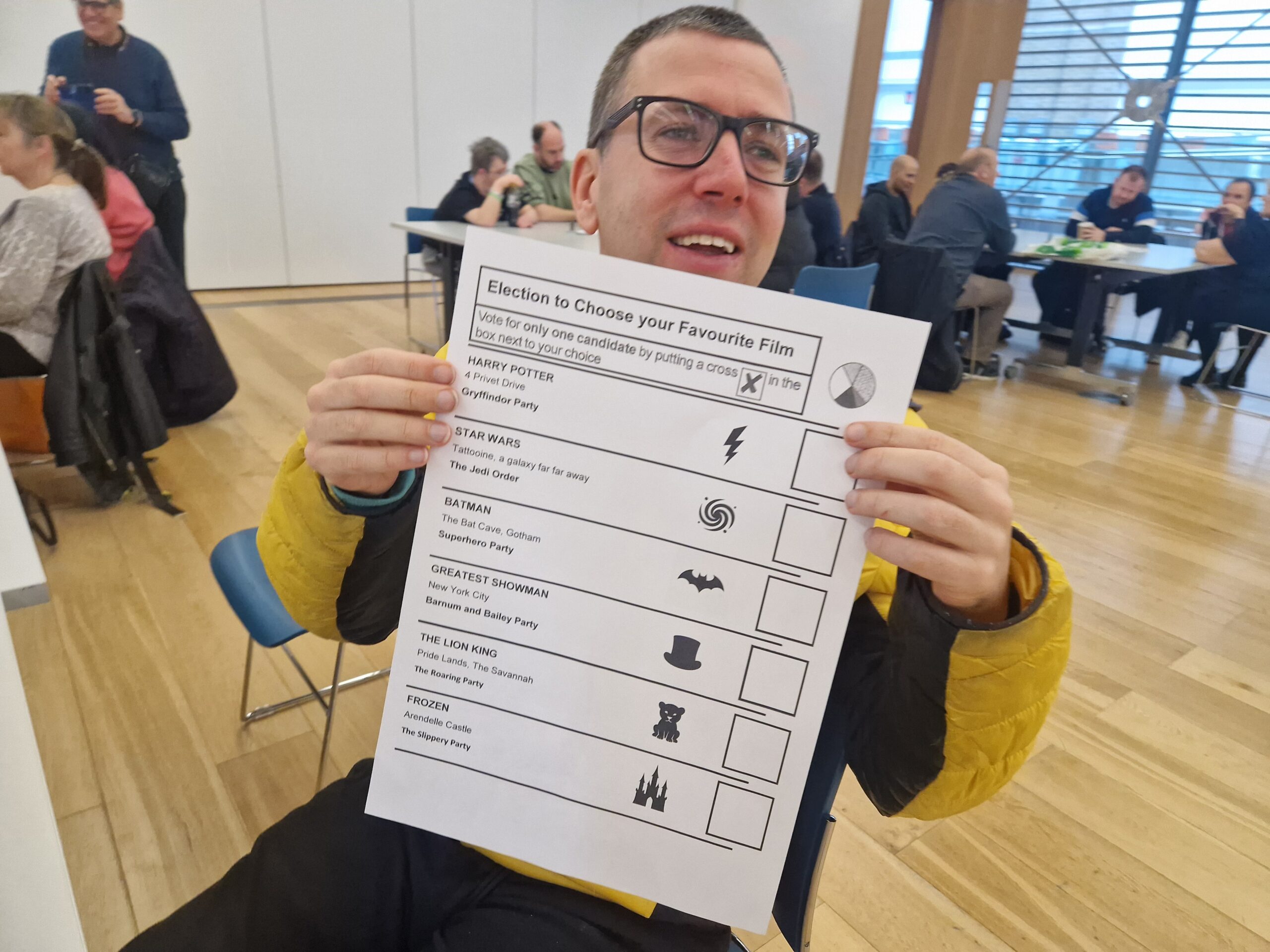
Image: the voting card for people to choose their favourite film
The vote this time was favourite films. The choices were Star Wars, The Greatest Showman, The Lion King, Batman and Frozen. We mocked up ballot papers with a made-up address and political party. ‘Batman, the Batcave, Gotham Superhero Party…’ We explained that, obviously, in a real election this would be a choice of political party or people that they might know in their community.
Maria: Those groups discussed their choices: ‘This is my favourite film because…’ They thought about how they were going to vote. At the end of the day, our chief exec came down to act as returning officer. We had the count and announced the winner, The Lion King — and people cheered. It felt like a real election.
You said people wanted to ask questions. What did they ask?
Maria: ‘Do I have to put a cross in the box?’ That’s something I learned from doing this: it doesn’t have to be a cross, as long as it’s a clear mark.
Another question was, ’Where do you take the voting papers to be counted?’ They didn’t know: they put their paper in the box and then off it would go. We explained that the papers go off to be counted, and that in a real election here that’s done at the local leisure centre. ‘Oh,’ they’d say, ‘I go there!’ It was just familiarising them with the whole process, so they feel on top of it.
Laurel: I used that to test how much they were listening and following what was being said. I told them that when the votes arrive at the leisure centre, we throw them all in the swimming pool! Ha ha, they all said, ‘Nooo!’ I explained I was joking, and was checking to see they were listening. In fact, they were very engaged.
I think the thing I learned was how much it helped to have a range of different people from my team, so there were young officers as well as more experienced ones. You could see that some people related better to the younger, junior officers, and some went for the senior ones.
Another thing is that we didn’t allocate tables to the groups, they could sit where they liked. They’d sit with people they knew, sometimes at the same table, sometimes at the next table, and they’d talk. The interaction between then was fantastic. I’ve been to senior management meetings where no one interacts, but here it was, ‘Oh hello, I’ve not seen you for a while, do you know…’ And they’d bring other people into the conversation. I think that’s because they were used to meeting each other at different times in other activities run by our adult social care teams, so we benefited from that.
Maria: I think the Learning Disability Partnership Board is a good example of that. It came up with the idea of having mock elections. It also has a say on other things we do across Bexley. Adam is one of our ‘easy read’ advisers, and has provided training sessions for us.
Adam: I’ve done ‘easy read’ sessions for loads of people — student nurses, doctors in their surgeries, members of the council — about making things accessible for everyone.
Maria: I’ve sat in meetings with Adam where he’s spoken up: ‘This document isn’t accessible for me to read.’ We’re very grateful for that kind of guidance.
Elizabeth: These groups and speaking-up activities often lead to further conversations about things we can be doing, or that partner organisations can come in on. That’s how these mock elections came about.
What did these mock elections cost to run?
Maria: That’s the amazing thing: there wasn’t really a cost, beyond mailing out the invitations. We also produced an easy-read poster for the first mock election and for the second we had an easy-read guide to what what was going to happen. There was the cost of printing and postage for that. Otherwise, we used the civic offices to host the elections, and there was staff time.
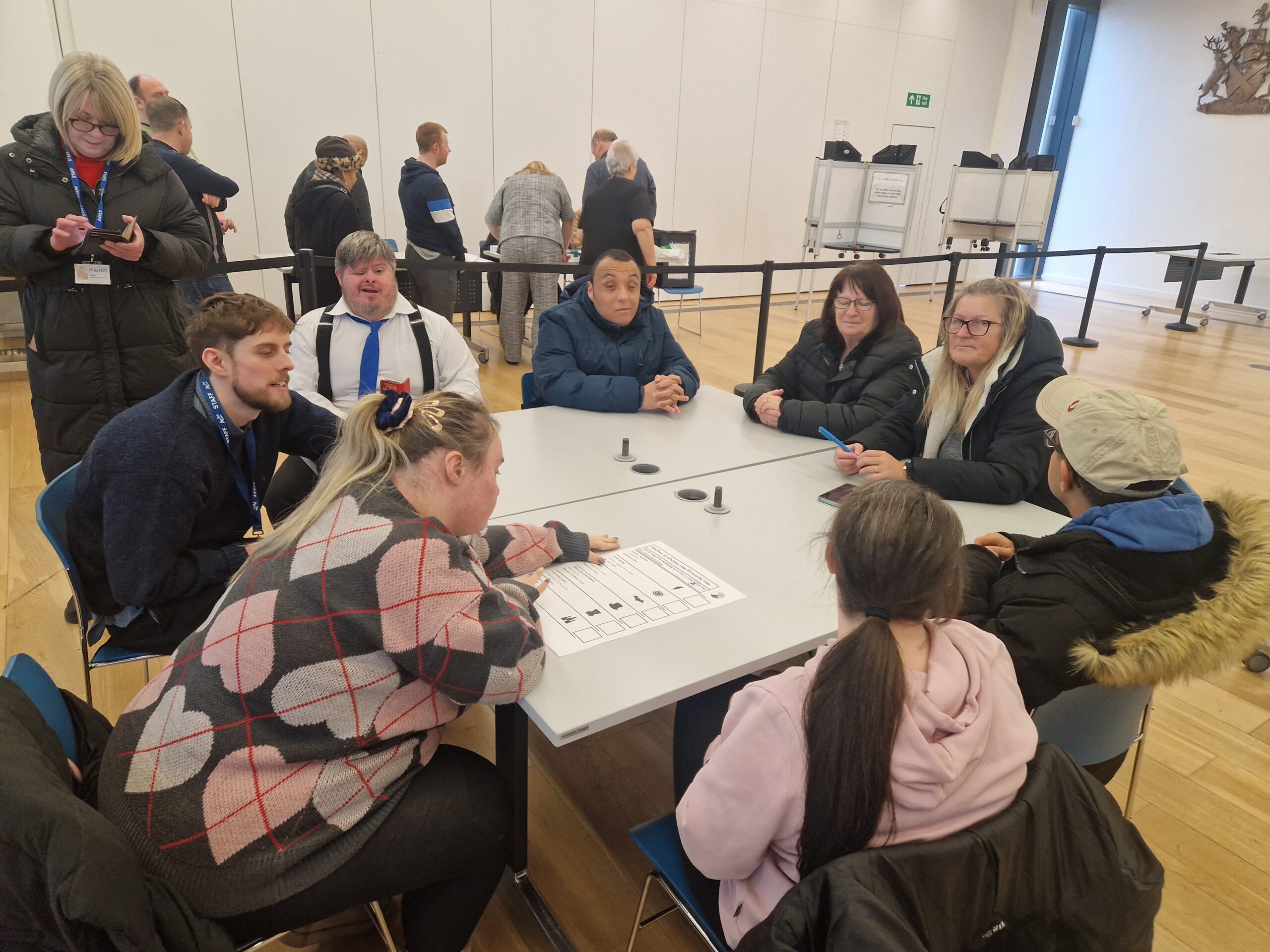
Image: some of the participants of the second mock election
Will there be a third mock election and, if so, what will be different?
Laurel: Yes there will, though we’ve not properly discussed it yet. I’ve some ideas about what we could do differently. I’d like to invite people back who came along to the previous elections and give them something new to do.
Elizabeth: My feeling is that what works best is keeping the focus on what happens in real elections. As a council, we have to remain absolutely neutral politically, but our amazing partners at Mencap are going to hold hustings events around the local elections in May. Those will cover the essentials of how to vote, but with representatives from the real political parties coming to speak and answer questions. That will be really interesting to see. We could all learn a lot.
We look forward to hearing more. Thank you all very much.
Image credit: Learning Disability Partnership Board
Other features:
Pressure mounts on X as critics rally against Grok deepfakes
Leave a Reply